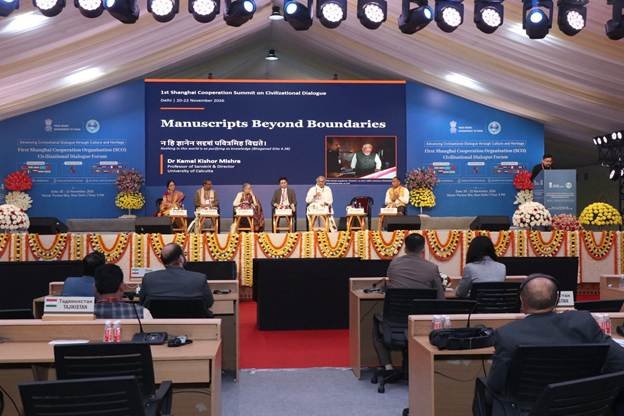
NEW DELHI — Academics and representatives from Shanghai Cooperation Organisation (SCO) member states and dialogue partners met at Purana Qila on November 22, 2026, for a session focused on manuscript heritage, linguistic history, and digital archiving under the Ministry of Culture’s Gyan Bharatam Mission.
Hosted during the first SCO Civilization Dialogue Forum—which ran from November 20 to 22 following an opening address by Prime Minister Narendra Modi—Session IV centered on language, literature, scripts, and manuscript traditions covering subjects from governance and economics to medicine, astronomy, and sustainable living. Guided by the Rigvedic verse “ā no bhadrāḥ kratavo yantu viśvataḥ”, speakers examined how ideas moved across regions via script, speech, and scholarship.
Mission Overview and Digital Milestones
Gyan Bharatam chief executive and Culture Ministry joint secretary Inderjeet Singh outlined the initiative’s core pillars for attending delegates: surveying and cataloguing, conservation and skill-building, digital and technical tools, linguistic and translation work, plus research, publishing, and public outreach. He noted that more than 1.26 crore manuscripts have been recorded nationwide through the survey effort, and pointed to AI-enabled tools including Gyan-MitramAI, Pandulipi Darpana, and BharatiyaGPT.
“For the Gyan Bharatam Mission, this is both a responsibility and an invitation to work together.” Singh added that regional scripts across SCO nations matter for cross-border dialogue and creating a shared digital archive of historical records.
Moderating the gathering, Gyan Bharatam project director Anirban Dash remarked that speech shapes ideas, written works safeguard them, and historical folios transmit insight across eras and geographies through adaptation and translation.
Four Thematic Tracks and Scholarly Perspectives
Deliberations structured around four focus areas examined Asian script influences, textual movement and translation, global dispersal of Indian manuscripts, and digital recovery:
- Regional Scripts and Silk Route Links: Jawaharlal Nehru University’s Rajnish Kumar Mishra discussed linguistic variety across Asia, maritime and Silk Route cultural exchange, figures such as Shankaracarya, Ramashekhar, and Acarya Abhinavagupta, and regional textual variants.
- Digitization and Archival Ties: University of Calcutta’s K.K. Mishra called for broader scanning, multi-language translation, expanded AI applications, and global reach via an NDR, citing institutions and partners including BnF, Google Arts & Culture, Thailand, Vietnam, Mongolia, and Russia alongside historical links involving translators, travelers, and Nalanda.
- Safeguards Against Misappropriation: TKDL Unit head Viswajanani J. Sattigeri addressed digital preservation and intellectual property safeguards, emphasizing patent classifications, structured metadata, and controlled database access to prevent piracy or unauthorized use.
- Accurate Translation and Longevity: IIT Bombay’s K. Rama Subramaniyam pointed to the Pañcatantra—translated into more than 50 languages such as Arabic and Persian—to argue for unbiased rendering, noting that old manuscripts preserve both written thought and centuries of historical continuity.
Regional Participation and Future Cooperation
Representatives from Iran, Kyrgyzstan, Pakistan, Cambodia, Uzbekistan, Laos, and Nepal joined the exchange, presenting local safeguarding initiatives and signaling interest in working with India’s Gyan Bharatam effort. Participants closed by backing closer ties in conservation, script instruction, comparative literature, cataloguing, scholar exchanges, regulated digital access, and joint studies across the SCO sphere.
PIB