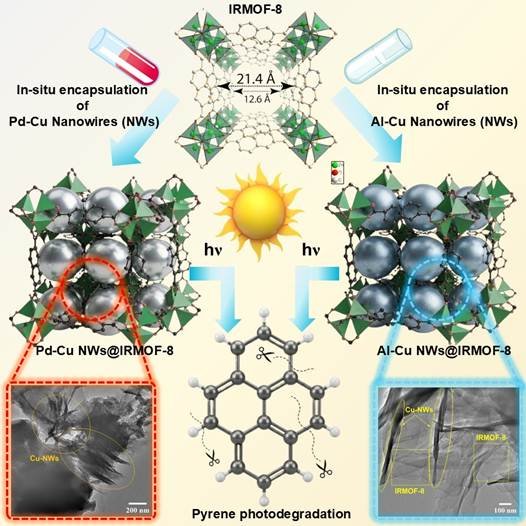
GUWAHATI — Researchers have engineered a hybrid material that embeds metallic nanowires inside a metal–organic framework (MOF) to capture broad-spectrum light and break down persistent contaminants such as pyrene, a toxic polycyclic aromatic hydrocarbon.
Pyrene resists breakdown in the environment and harms living organisms, prompting ongoing research into porous metal–organic frameworks—molecular structures with wide internal channels capable of hosting gases and chemical compounds, a field honored by the 2026 Nobel Prize in Chemistry.
How the Hybrid Material Works
One-dimensional metal nanowires conduct electricity well and interact strongly with light, making them useful for optical and energy applications. Through plasmonic photocatalysis, light-driven reactions can draw on both visible and near-infrared wavelengths, allowing combination with porous frameworks to merge traits from each building block.
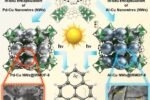
A team at Guwahati’s Institute of Advanced Study in Science and Technology (IASST), an autonomous body under the Department of Science and Technology (DST), created a composite built from copper nanowires (Cu NW) held within an isoreticular metal–organic framework-8 (IRMOF-8) structure, paired with palladium (Pd) nanostructures to boost light capture and catalytic breakdown.
Palladium vs. Aluminum and Test Results
Aluminum (Al) was tested alongside palladium because aluminum is widely available, inexpensive, and displays energetic plasmonic behavior. Inside the porous IRMOF-8 matrix, components sit in close proximity, supporting charge movement across interfaces.
Adding palladium boosted wide-band light absorption through plasmonic effects, whereas the aluminum variant functioned as an antenna-reactor arrangement that aided charge transfer and breakdown of polybenzenoid aromatic pollutants. During testing involving light exposure and ultrasonication, the palladium-modified copper-nanowire framework removed 99% of pyrene, while the aluminum-modified version removed 85%.
Research Team and Publication
Led by Prof. Devasish Chowdhury and doctoral researcher Netra Prova Baruah alongside collaborators Mojibur R. Khan, Mandira Thakur, Ipsah Akhtar, Rahul Sonkar, and Arundhuti Devi, the work appeared in ACS Applied Energy Materials (DOI: 10.1021/acsaem.6c02080) as a route toward solar-driven cleanup of aquatic environments.
“The research is also an effort to develop aluminum (Al) -based system, which exhibited substantial photocatalytic performance, accentuating its potential to reduce reliance on noble metals,” said Prof. Chowdhury.
PIB