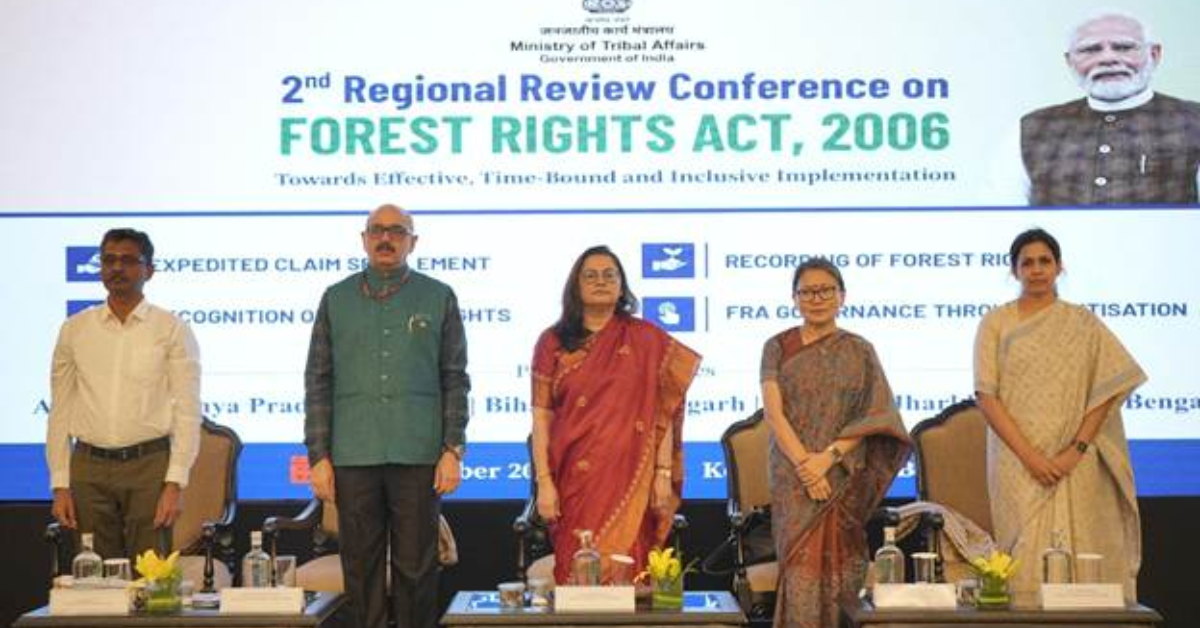
KOLKATA — The Ministry of Tribal Affairs (MoTA) convened the Second Regional Review Conference on the implementation of the Scheduled Tribes and Other Traditional Forest Dwellers (Recognition of Forest Rights) Act, 2006 (FRA) in Kolkata, West Bengal.
The high-level meeting brought together senior administrative heads, revenue and forest officials, and Tribal Research Institutes from eight States: West Bengal, Assam, Tripura, Jharkhand, Odisha, Bihar, Madhya Pradesh, and Chhattisgarh. Additionally, senior officials from Andhra Pradesh participated as special invitees to share best practices in digital integration and livelihood convergence.
Key Highlights & National Status
National Statistics (as of August 31, 2026): Over 54 lakh claims have been received nationwide, with roughly 25 lakh titles distributed. However, 11 lakh claims remain pending at various stages, and over 18 lakh claims have faced rejection.
High-Pendency Focus: The Ministry flagged that Madhya Pradesh, Odisha, and Assam account for substantial claim pendencies concentrated within specific districts, urging targeted district-level interventions.
Special Invitee Best Practices: Andhra Pradesh was lauded for its pioneering digitization models, seamlessly integrating FRA titles into government land records and leveraging post-claim support schemes. Odisha and Chhattisgarh were similarly recognized for leadership in securing Habitat Rights for Particularly Vulnerable Tribal Groups (PVTGs) and processing high volumes of Individual Forest Rights (IFR).
Core Priorities Outlined by MoTA
Disposal & Review of Claims: Directives were issued for the transparent, time-bound disposal of pending files and a formal review of rejected claims in strict compliance with FRA rules.
Record Incorporation & Digitization: States were instructed to integrate recognized forest rights into revenue and forest registers with accurate mapping, supported by the newly demonstrated National-level FRA Portal and Mobile App.
Empowering Gram Sabhas: Emphasizing that Community Forest Resource Rights (CFRR) require active management capability, MoTA called for robust Gram Sabha capacity-building. States were urged to operationalize the joint advisory issued alongside the Ministry of Environment, Forest and Climate Change (MoEFCC) to merge CFR management plans with departmental working plans without compromising Gram Sabha authority.
PVTG Habitat Rights Roadmaps: Sensitive, consultative roadmaps involving traditional tribal institutions must be deployed to secure habitat rights for all PVTG communities.
Livelihood Convergence: Recognized rights holders must seamlessly access developmental benefits, housing, productive land use, and credit facilitation schemes.
The conference concluded with state-specific presentations outlining actionable roadmaps for data reconciliation, digital API integration, and clearing backlogs across high-priority districts.
Source : PIV