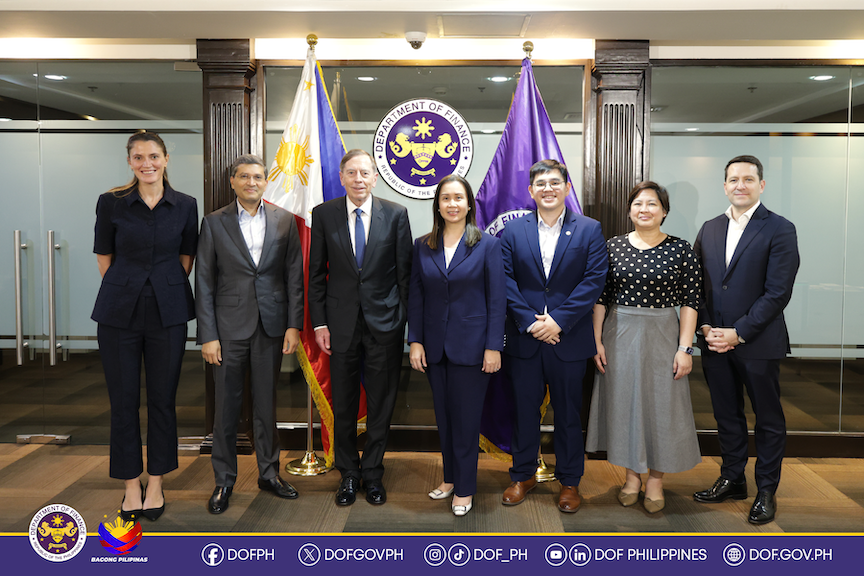
Finance Undersecretary Ma. Angela E. Ignacio and KKR Global Institute Partner and Chairman General David H. Petraeus discuss ways to strengthen financing opportunities for priority projects in the country
The Department of Finance (DOF) and US global investment firm Kohlberg Kravis Roberts and Co. Inc. (KKR Co. Inc.) are exploring ways to finance priority projects under the Luzon Economic Corridor (LEC), which aims to generate employment opportunities and strengthen the country’s position as a top financing destination in Asia.
On behalf of Finance Secretary Frederick D. Go, Government Corporations and Investments Group (GCIG) Undersecretary Ma. Angela E. Ignacio met with KKR Global Institute Partner and Chairman General David H. Petraeus, during which KKR reaffirmed its support for the Philippines and expressed interest in expanding its investment portfolio in the country.
“Through strategic reforms aimed to streamline ease of doing business, we are committed to attract more partnerships to strengthen key industries and bolster our position as a top investment destination in the region,” Undersecretary Ma. Angela E. Ignacio said.
KKR & Co. Inc. is a leading global investment firm managing around USD750 billion in assets across private equity, infrastructure, credit, and real assets.
The firm has deployed Assets Under Management (AUM) of more than USD2 billion in the Philippines, with investments in priority sectors such as digital finance, infrastructure, and essential services.
“The KKR Global Institute has pushed coming into the Philippines way back. The macro circumstances were such that we felt we should get in here. This is a young country, has grown fast, and needs infrastructure and other financing to do well,” KKR Partner and Chairman David H. Petraeus said.
During the meeting, Undersecretary Ignacio highlighted the LEC’s progress which has attracted more partners to strengthen artificial intelligence (AI) infrastructure, information and communications technology (ICT), and the energy industry.
KKR executives identified opportunities for investment in the Philippines’ fintech, healthcare, energy, telecommunications infrastructure, and education, as well as in semiconductor, advanced manufacturing, critical minerals, energy, logistics, and digital infrastructure industries.
They likewise emphasized the importance of sustained investments in human capital development, infrastructure, and policies will be crucial in securing more long-term financing opportunities for the country.
In support of this, the Philippine government has passed reforms to strengthen the investment climate and make it easier for investors to pursue long-term projects.
These include the Corporate Recovery and Tax Incentives for Enterprises to Maximize Opportunities for Reinvigorating the Economy (CREATE MORE) Act, the new PPP Code, Investors’ Lease Act, Green Lanes for Strategic Investments, Accelerated and Reformed Right-of-Way (ARROW) Act, Capital Markets Efficiency Promotion Act (CMEPA), and the Enhanced Mining Fiscal Regime Act.
Philippine Information Agency, PR