NEW DELHI — India has committed INR 15,000 crores (NPR 24,000 crores) in development assistance to Nepal and unveiled major connectivity, energy, and institutional agreements during Nepal Prime Minister Balendra Shah’s inaugural state visit to India on November 22–23, 2026.
Arriving in New Delhi with a senior delegation after taking office, Shah received a ceremonial welcome at Rashtrapati Bhavan, paid respects at Rajghat, and held meetings with Indian President Droupadi Murmu and External Affairs Minister S. Jaishankar before sitting down with Indian Prime Minister Narendra Modi. During their discussions, Shah thanked India for relief and technical aid following the Rasuwa-Bhotekoshi floods, which caused heavy casualties and property damage in Nepal.
Development Package and Joint Vision
The financial package announced by New Delhi pairs INR 3,500 crores (NPR 5,600 crores) in grant funding—earmarked for post-disaster recovery and fresh infrastructure—with an INR 11,500 crore (NPR 18,400 crore) Rupee-denominated Line of Credit targeting power sector projects. Both governments will hold consultations to settle specific project selections and implementation terms.
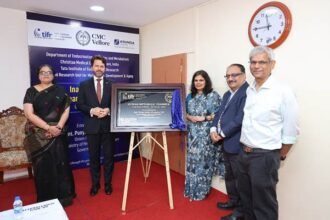
Modi and Shah also endorsed a Joint Vision for a “Viksit Bharat and Samunnat Nepal” to guide ties across traditional pillars—trade, energy, water, infrastructure, and cultural links—while expanding cooperation into start-ups, digital systems, space, sports, climate resilience, and disaster management. Plans to establish an offshore Indian Institute of Technology (IIT) campus in Nepal, build an Agro-Industrial Park in Chitwan with Indian grant support, and ease cross-border banking and telecom access for residents were also highlighted.
Rail, Aviation, Trade, and Border Links
Several transport and trade measures were rolled out during the visit:
- Railways: Modi and Shah launched passenger operations on the Sarayu-Kamala Express linking Ayodhya and Janakpur to bolster cultural and religious tourism along the Ramayana Circuit, while agreeing to study similar routes for Buddhist and Shiv-Shakti circuits. Both sides also reported completing the Field Location Survey for a proposed electrified broad-gauge line between Raxaul and Kathmandu and pledged cooperation on Nepal’s East-West Railway.
- Aviation and Maritime Trade: The two nations agreed to convert the one-way B345 air route connecting Kathmandu, Bhairahawa, and Lucknow into a two-way corridor, subject to technical talks. Modi also opened transit trade access via Deendayal Port in Kandla, Gujarat, with Paradip Port in Odisha set to follow once required facilities are ready.
- Cross-Border Infrastructure and Boundaries: Leaders virtually broke ground on an Integrated Check Post (ICP) at Banbasa, reviewed ongoing work at Bhairahawa, Sunauli, and Dodhara-Chandani alongside three already-operating ICPs, and opened a motorable bridge linking Dharchula in India with Darchula in Nepal. They noted progress on boundary pillar upkeep and instructed foreign secretaries to address unresolved border questions.
Energy and Water Cooperation
Energy and river management featured prominently on the agenda. Both sides dedicated the second phase of the Motihari-Amlekhgunj petroleum pipeline, virtually laid the foundation stone for a petroleum terminal in Jhapa, Nepal, stressed early work on a Siliguri-Jhapa fuel pipeline, and agreed to look into natural gas pipelines.
In hydropower, Modi and Shah virtually initiated work on the 669 MW Lower Arun Hydro-Electric Project, backed faster execution of projects led by Indian firms, and noted joint-venture progress on high-capacity transmission lines between Inaruwa and New Purnea, and between Dododhara and Bareilly. They urged faster completion of Detailed Project Reports for the Pancheshwar Multipurpose Project—through the Pancheshwar Development Authority and the Joint Committee on Water Resources—as well as the Saptakoshi and Sunkoshi multipurpose projects to boost power generation, share water benefits, and curb flood risks.
Signed Memoranda and Next Steps
Eight bilateral agreements were exchanged covering forensic science research, police academy training, civil service capacity building, Ayurveda and traditional medicine, satellite communications using the South Asia Satellite, sustainable urban development, health and medicine, and livestock and fisheries.
Shah extended an invitation to Modi to visit Nepal, which Modi accepted with dates to be arranged diplomatically.
PIB