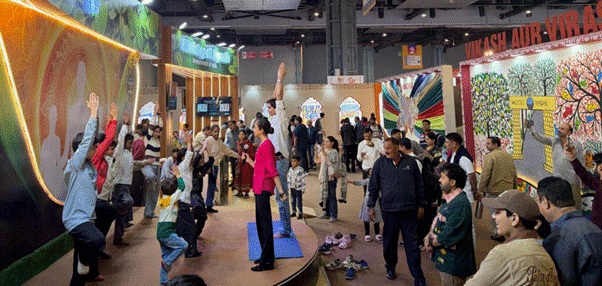
NEW DELHI — Visitors attending the 45th India International Trade Fair (IITF) 2026 are turning out in large numbers for no-cost health check-ups, wellness workshops, and interactive exhibits hosted by the Ministry of Ayush inside Hall No. 2 at Bharat Mandapam.
Running from November 13 through November 27, the Ayush Pavilion pairs traditional medical systems with hands-on demonstrations focused on everyday wellness and disease prevention. Its display centers on the theme “Ayush Ki Virasat Se Swasth Bharat Ka Vikaas” (आयुष की विरासत से स्वस्थ भारत का विकास), matching the wider fair motto, “Development and Heritage” (विकास और विरासत).
Ayurveda and Dietary Exhibits
Several bodies under the ministry have set up clinical and educational booths around classical healing and nutrition:
- Outpatient Care and Herb Education: The CCRAS–CARI unit is running Ayurveda outpatient services alongside Prakriti Pariksha assessments and guidance on preventive routines. Meanwhile, the All India Institute of Ayurveda (AIIA) in New Delhi showcases familiar botanicals—including Ashwagandha, Shatavari, Arjuna, Amla, Haridra, and Guduchi—explaining classical uses while cautioning attendees to check proper doses, personal medical factors, and expert advice prior to taking herbal remedies.
- Games, Virtual Reality, and Millet Foods: Jaipur’s National Institute of Ayurveda (NIA) presents Ayush Aahar items like Ragi Cookies, Triphala Jam, Aloe Vera Gel, and herbal Lip Balm, paired with virtual reality views of human organ systems, educational materials on Prakruti, Panchakarma, and Ayurvedic cooking, plus a Snakes and Ladders board game centered on Ahara (diet) and Vihara (lifestyle). Separately, Rashtriya Ayurveda Vidyapeeth (RAV) features POSHAK cookies, Ayurvedic bread, and Pankam, running sessions such as “Dadi Se Puchho” and “Millets on the Wheel” to highlight traditional meals and millet nutrition.
Yoga, Unani, Siddha, Naturopathy, and Sowa-Rigpa
Across the pavilion, specialty councils are combining practical sessions with digital tools and food sampling:
- Yoga Sessions: Morarji Desai National Institute of Yoga (MDNIY) leads regular practice slots on a dedicated stage, offers one-on-one yoga advice tailored to age, health needs, and daily habits, and hosts quizzes and asana contests.
- Unani Care and Kiosks: Operated by New Delhi’s Regional Research Institute of Unani Medicine (RRIUM) under the Central Council for Research in Unani Medicine (CCRUM), the Unani counter offers samples of Unani Qahwa, Hareera, Halwa Gheekawar, Gulkand, and Murabba Amla, screens documentaries and digital presentations, and runs a modified digital Mizaj Assessment Kiosk for temperament checks and diet tips. Across November 18 and 19, its outpatient clinic gave free consultations and medicines to 151 people.
- Siddha and Naturopathy: Chennai’s National Institute of Siddha (NIS) and the Central Council for Research in Siddha (CCRS) present Siddha Ahar, nutrition, lifestyle changes, diagnostics, traditional preparations, and Varma therapy alongside BSMS, MD (Siddha), and PhD study pathways. Elsewhere, the Central Council for Research in Yoga & Naturopathy (CCRYN) pairs audiovisual displays and informational handouts with snacks like Makhana Ladoo, Peanut Ladoo, Til Ladoo, and Namkeen, having offered free consultations on yoga, naturopathy, diet, and lifestyle on November 17 and 18.
- Himalayan Healing and Medicinal Plants: The National Institute of Sowa-Rigpa shares guidance drawn from classical texts on diet, therapies, and herbal remedies. At the same time, the National Medicinal Plants Board (NMPB) exhibits live plants—many tagged with QR codes for digital details—hands out Satavari plants, and distributes pamphlets, brochures, and the comic book “Professor Ayushman.”
Taken together, the exhibits and participatory sessions give trade fair guests a direct look at how traditional medicine and preventive habits fit into modern daily routines.
PIB