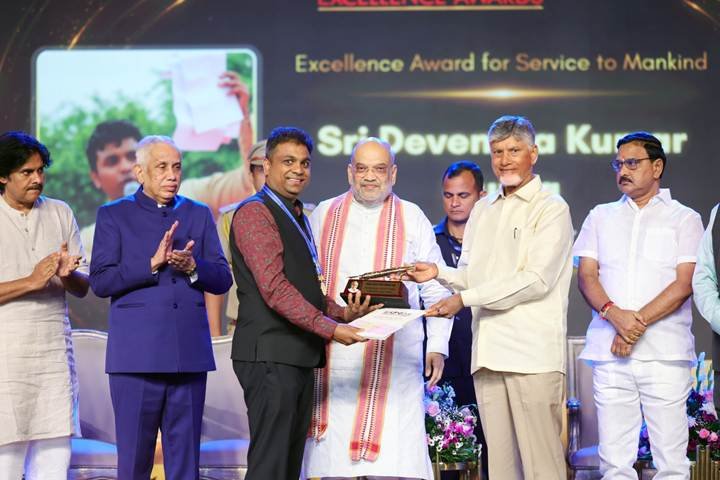
VIJAYAWADA, November 16, 2026 — Union Minister of Home Affairs and Cooperation Amit Shah attended the Ramoji Excellence Awards 2026 in Vijayawada on Monday, commemorating the 90th birth anniversary of the late media baron Ramoji Rao while outlining major economic and infrastructure developments in Andhra Pradesh and across India.
The ceremony was attended by Andhra Pradesh Governor Syed Abdul Nazeer, Chief Minister N. Chandrababu Naidu, Deputy Chief Minister K. Pawan Kalyan, and Union Ministers G. Kishan Reddy and K. Ram Mohan Naidu. Nine individuals were honored during the event for contributions spanning science and technology, journalism, healthcare, education, arts and culture, rural development, youth leadership, women’s achievement, and humanitarian service.
Tribute to Ramoji Rao’s Media and Film Legacy
Reflecting on Rao’s career, Shah noted that the late founder of the Eenadu group built enduring institutions rather than mere commercial ventures, comparing his impact on Indian journalism to that of Ram Nath Goenka. Shah recalled meeting Rao four times and praised his grasp of grassroots issues nationwide, including his detailed knowledge of Northeast India’s demographics and insurgency challenges.
Born into a modest farming household in Krishna district without inherited wealth or formal journalism training, Rao launched the Telugu daily “Eenadu” and later expanded into 24-hour regional television broadcasting through the ETV network, eventually pioneering mobile television platforms. Shah noted that Rao upheld editorial independence despite financial losses and external pressures, adding that his 2016 Padma Vibhushan recognized his broader service to literature, journalism, and Telugu culture. He also credited Ramoji Film City with transforming Indian cinema by offering comprehensive production facilities under one roof.
National Economic and Infrastructure Benchmarks
Turning to national governance under Prime Minister Narendra Modi, Shah stated that administrative stability over the past 13 years had replaced policy stagnation with measurable execution. He cited the abrogation of Article 370 and the elimination of annual Naxalite attacks—which previously exceeded 2,000 incidents per year—as key security milestones.
Presenting economic figures, the Home Minister highlighted several benchmarks:
- Growth and Exports: Moody’s recently upgraded India’s 2026–27 GDP growth projection from 6.5% to 7%. Following record exports of $863 billion in 2025–26, India is targeting the $1 trillion mark.
- Industrial and Transit Expansion: Domestic steel output has risen 90% since 2014, making India the world’s second-largest producer ahead of the United States and Japan combined. Airport infrastructure has expanded from 76 to 150 facilities, alongside the deployment of an indigenously built hydrogen train.
- Digital and Social Indicators: BharatNet connectivity has scaled from 58 Gram Panchayats in 2014 to 215,000 today, bringing 4G access to 98% of Indian villages. Shah also referenced a World Bank report indicating that 500 million Indians moved out of poverty over the past 12 years.
Andhra Pradesh’s Development Trajectory
Commending Chief Minister Chandrababu Naidu’s administration, Shah projected that Andhra Pradesh is positioned to become India’s most developed state within the next decade, noting that the state has secured ₹30 lakh crore in investments over the past two and a half years.
Key projects cited by the Home Minister include Google’s $15 billion artificial intelligence hub and one-gigawatt data center in Visakhapatnam—its largest outside the United States—as well as an upcoming undersea cable gateway, the state’s first semiconductor unit, and new steel plants. Shah also pointed to the recent inauguration of the Alluri Sitarama Raju International Airport, alongside ₹18,000 crore in newly launched projects, and emphasized that timely completion of the Polavaram Dam will provide a long-term irrigation solution for the state’s agricultural sector.
PIB