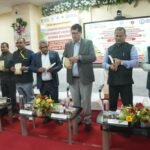

NEW DELHI, Nov 12: Bridging the gap between indigenous agricultural practices, scientific innovation, and commercial markets is essential to empowering Indian cultivators, according to Dr. P.K. Mishra, Principal Secretary to the Prime Minister. Speaking on Thursday at the 22nd Foundation Day and Plant Genome Saviour Award ceremony hosted by the Protection of Plant Varieties and Farmers’ Rights Authority (PPVFRA), Mishra urged stakeholders to view farmers not just as growers, but as key innovators and guardians of the nation’s crop diversity.
The event also commemorated 25 years since the enactment of the Protection of Plant Varieties and Farmers’ Rights Act of 2001. Mishra noted that this legislation uniquely balances commercial breeders’ interests with legal protections for rural communities who cultivate, preserve, and develop native seeds. Currently, farmer-developed crops account for roughly 50 percent of all varieties registered with the PPVFRA.
Addressing the economic realities of conservation, Mishra stressed that symbolic recognition alone cannot sustain rural livelihoods. “An award honours a farmer once, while availability of seeds, markets and a fair share in profits make the farmer economically strong every season,” he stated, advocating for stronger community seed banks, transparent benefit-sharing frameworks, and expanded market access through Farmer Producer Organizations (FPOs).
On the scientific front, Mishra pointed out that the ICAR-NBPGR National Gene Bank ranks as the second-largest facility of its kind globally. Through the National Agricultural Research System, Indian scientists have produced close to 3,000 crop varieties engineered to withstand climate shifts, pests, and water shortages. He further identified Geographical Indications (GIs) as a vital tool for boosting the market value of region-specific produce.
India’s diverse agricultural landscape encompasses 22 recognized agrobiodiversity hotspots. Mishra highlighted Odisha’s Koraput region—designated a Globally Important Agricultural Heritage System by the UN’s Food and Agriculture Organization (FAO) in 2012—as a prime model of community-driven preservation.
Internationally, India has positioned itself at the forefront of genetic resource governance through several milestones, including hosting the International Treaty on Plant Genetic Resources Governing Body in 2022, organizing the 2023 Global Symposium on Farmers’ Rights, and contributing to the BRICS Agriculture Ministers’ Indore Declaration and the Global Platform on Farmers’ Rights in Seed Systems.
Concluding his remarks, Mishra called upon scientists, universities, private industry, and government bodies to share the responsibility of safeguarding crop diversity alongside growers, adding: “An award honors a farmer once, while availability of seeds, markets, and a fair share of profits make a farmer economically strong season after season.”
PIB