NEW DELHI — Union Home Minister and Minister of Cooperation Amit Shah announced on November 19, 2026, that Kashmir no longer has any active locally recruited militants born in India, following the killing of Lashkar-e-Taiba operative Latif Bhat the previous day—a milestone reached after 35 years.
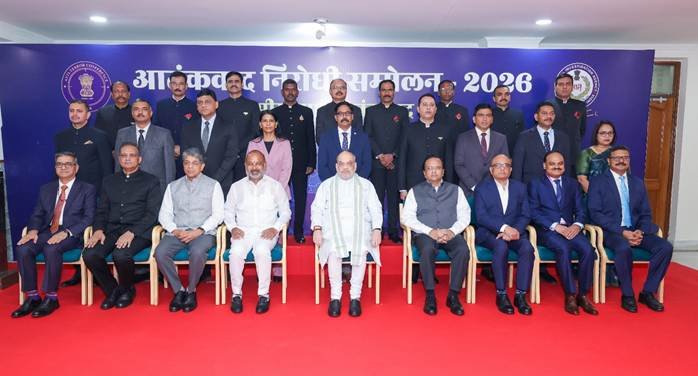
Speaking at the opening session of a two-day national counter-terrorism conference in New Delhi, Shah outlined a nationwide strategy aimed at linking every police station under a unified anti-terror framework. The event brought together senior police officials from states and Union Territories alongside legal, forensic, and technology specialists. Attendees included Union Minister of State for Home Affairs Bandi Sanjay Kumar, Union Home Secretary Govind Mohan, Intelligence Bureau Director Dr. Mahesh Dikshit, Special Secretary (Internal Security) Anand Swarup, and National Investigation Agency (NIA) Director General Rakesh Aggarwal.
Crackdowns on Terror Networks and Fugitives
During his address, Shah detailed recent enforcement actions and urged state police forces to focus on preemptive arrests before attacks occur:
- Shahzad Bhatti Network: Authorities designated the Shahzad Bhatti network as a terrorist organization under the Unlawful Activities (Prevention) Act (UAPA), neutralizing over 40 modules nationwide, filing more than 100 cases, and arresting over 271 individuals.
- Extradition Drive: Since launching a dedicated repatriation campaign in 2019, Indian agencies—led by the Central Bureau of Investigation (CBI) and the Ministry of Home Affairs—have returned 303 fugitives from 36 countries to face Indian courts.
- PFI Operations: Pointing to the September 2022 coordinated night raids across 11 states that dismantled the Popular Front of India (PFI) network, Shah described the joint central-state operation as a preventive measure that neutralized future security threats.
Institutional Expansion and Cyber Capabilities
Shah reviewed legislative and structural changes enacted since 2019, including amendments to the NIA Act and UAPA that expanded the agency’s jurisdiction, allowed property seizures, enabled individual terrorist designations, and authorized probes protecting Indians abroad. The NIA’s footprint has grown with the approval of 16 new branch offices, two zonal offices, 70 NIA Special Courts, and a 25-point action plan targeting terror financing.
Additionally, the Multi-Agency Centre (MAC) underwent a technological overhaul in 2023 to integrate cybersecurity, narcotics, organized crime, and emerging radicalization hotspots, supported by a centralized National Memory Bank. Calling for deeper Centre-State coordination, Shah urged state Anti-Terrorism Squads (ATS) to expand their cyber expert units, establish multi-tier intelligence channels from local stations up to state police chiefs, and prioritize a Quadrangular Regional Security Grid in border states.
Infrastructure Launches and Awards
On the sidelines of the conference, the Home Minister unveiled the NIA publication ‘Fail-Safe Investigation’, e-launched the agency’s ‘Pushti’ portal, and presented service decorations to seven NIA personnel. He also laid the foundation stone for a new NIA office complex in Chandigarh and inaugurated an NIA residential complex in Delhi’s Maidangarhi area.
PIB