Five projects worth ₹102 crore inaugurated and five more worth ₹228.54 crore receive foundation stones; initiatives target roads, electricity, water supply, healthcare, education, sports and culture.
Aizawl, October 12, 2026: Union Minister for Communications and Development of the North Eastern Region Jyotiraditya M. Scindia inaugurated five development projects and laid foundation stones for five additional projects worth a combined ₹331 crore in Mizoram on Monday. The initiatives are aimed at strengthening infrastructure, improving public services and expanding economic opportunities across the state.
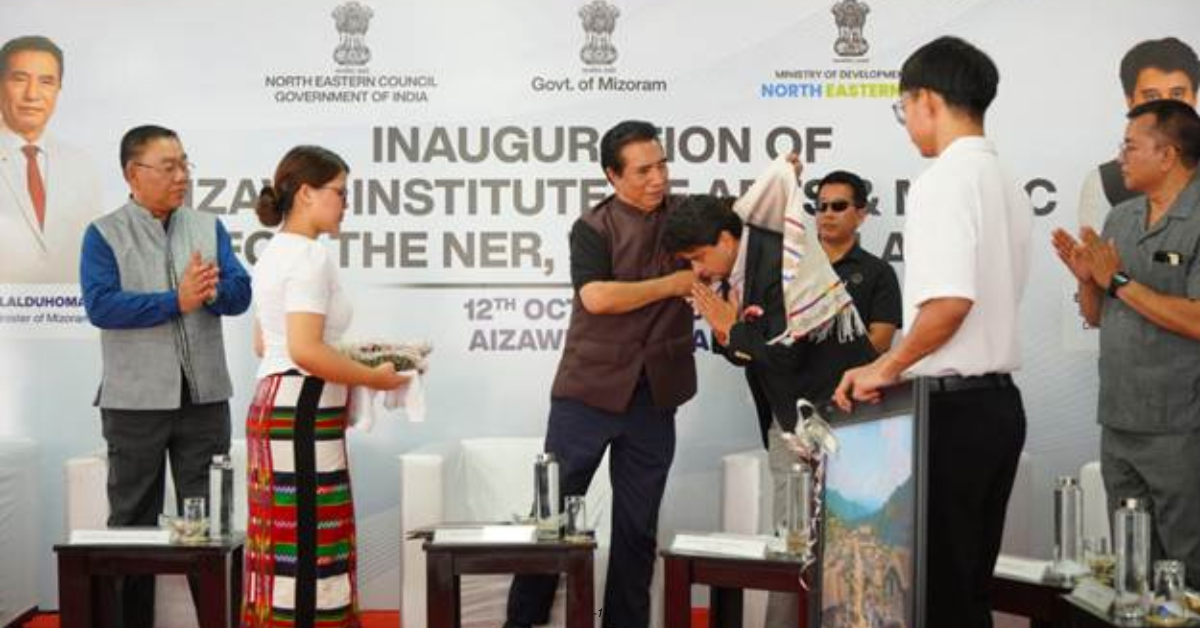
The programme took place at Tuivamit in the presence of Mizoram Chief Minister Pu Lalduhoma and other dignitaries during Scindia’s two-day visit to the state on October 12–13.
Of the total investment, projects worth approximately ₹102 crore were dedicated to the public, while five new projects valued at ₹228.54 crore received foundation stones. The initiatives cover road connectivity, electricity transmission, drinking water, healthcare, nursing education, sports facilities and cultural development.
Addressing the gathering, Scindia said infrastructure development should translate into tangible improvements in people’s lives, creating opportunities for farmers, entrepreneurs, young people and local communities. He also emphasised that Mizoram’s geographical challenges should not restrict its development potential.
Five Completed Projects to Improve Essential Services
The five projects inaugurated by the Union Minister include the Daido–Vangkawt Road in Champhai, developed at a cost of ₹17.24 crore, to improve access to the Mizo ginger-growing region and help farmers transport agricultural produce to markets.
A 132 kV Bairabi–West Phaileng transmission line via Mamit, costing ₹54.95 crore, is expected to strengthen the state’s electricity transmission network. The North Vanlaiphai Water Supply Scheme has also been augmented at a cost of ₹20.50 crore to improve water-supply infrastructure.
Other inaugurated facilities include an AYUSH Development Centre, developed at a cost of ₹2.64 crore, and the Aizawl Institute of Arts & Music for the North Eastern Region at Tuivamit Tlang, built with an investment of ₹6.90 crore. The arts and music institute is intended to promote local talent, preserve cultural traditions and create professional opportunities in the creative sector.
₹228.54 Crore Allocated to Five New Projects
The foundation stones were laid for five additional projects designed to strengthen connectivity and social infrastructure.
The largest of these is the Pukzing–Silsuri Road project in Mamit district, valued at ₹100.24 crore. The 21-kilometre road is intended to improve all-weather connectivity and access to essential services.
The Tualpui–Champhai Road project, costing ₹57.01 crore, will cover areas in Khawzawl and Champhai districts. Another project, the Oil Palm Link Road, has been allocated ₹26.49 crore for a 32.70-kilometre road network connecting areas across Kolasib, Mamit, Lunglei and Lawngtlai. According to the project details, the road is expected to benefit nearly 60,000 people across 19 villages.
The remaining projects include a 40-bed hostel for the Auxiliary Nurse Midwife (ANM) School at Zemabawk in Aizawl, with an investment of ₹10 crore, and sports infrastructure development worth ₹34.80 crore to support young athletes and strengthen Mizoram’s sporting ecosystem.
Northeast Emerging as a Major Growth Driver
Scindia highlighted the growing economic importance of the North Eastern Region, describing it as an increasingly significant contributor to India’s development. He said the region’s progress must combine infrastructure expansion with environmental protection and the preservation of its distinctive cultural identity.
The Minister also referred to improvements in railway connectivity, particularly the 51.38-kilometre Bairabi–Sairang railway line, which has connected Aizawl with the national railway network. According to the figures shared during the programme, the railway line had facilitated more than 15 lakh passenger journeys through over 1,100 train trips, connecting Mizoram with destinations including Guwahati, Kolkata and Delhi.
He also highlighted the movement of food grains by rail, including the arrival of a Food Corporation of India rake carrying approximately 26,000 quintals of rice from Punjab to Sairang in March 2026.
Tourism is another area showing potential. Scindia reported 4,94,362 domestic tourist visits and 7,389 foreign tourist visits to Mizoram during the first half of 2026, bringing the combined total to more than five lakh visits.
Ginger Mission to Support Nearly 20,000 Farming Households
The Union Minister highlighted the ₹189.79 crore Mizoram Ginger Mission as an important initiative to strengthen agricultural livelihoods. The programme aims to bring nearly 20,000 farming households into an integrated value chain covering cultivation, processing, branding, transportation and access to national and international markets.
The initiative seeks to ensure that farmers receive a greater share of the value generated from their agricultural produce rather than relying solely on increased production.
Scindia also announced that the Ministry of Development of North Eastern Region (DoNER) had been allocated ₹6,812.30 crore for the North Eastern Region in the 2026–27 financial year.
He stated that Mizoram had taken up 375 projects worth ₹4,617.70 crore, of which 295 projects involving ₹2,692.31 crore had already been completed.
Development Alongside Cultural and Environmental Protection
Concluding his address, Scindia invoked Mizoram’s traditional community spirit of Hnatlang, which involves people voluntarily working together for the welfare of their villages and neighbours. He described cooperation between the Central Government, the state government and local communities as essential to achieving sustainable development.
He stressed that the success of development initiatives should be judged by their real impact, including better market access for farmers, improved healthcare, stronger educational opportunities and more facilities for young people.
The visit is scheduled to continue through October 13, with engagements involving students, civil society representatives and banking-sector stakeholders. The initiatives form part of the broader effort to strengthen infrastructure, economic inclusion and development across Mizoram and the wider North Eastern Region.
Source : PIB