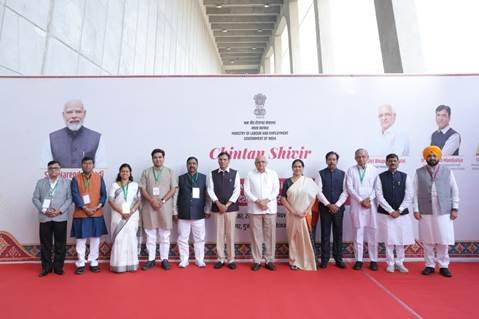
Gandhinagar’s Mahatma Mandir opened a two-day brainstorming session on Saturday bringing together state and union territory ministers responsible for labour and employment. Scheduled across November 21 and November 22, 2026 by India’s Ministry of Labour and Employment, the meeting marks the first anniversary since the Labour Codes came into effect on November 21, 2025.
Opening proceedings were co-chaired by Gujarat Chief Minister Bhupendra Patel alongside Union Minister for Labour & Employment and Youth Affairs & Sports Mansukh Mandaviya. Minister of State Shobha Karandlaje, state and territory ministers handling labour, employment, and industry portfolios, and senior government officials also joined the gathering.
Labour Reform and Social Security
Speaking at the start of the conference, Mandaviya compared employee well-being and factory expansion to twin wheels driving national advancement. Balancing business growth with safeguards for staff remains central to India’s economic trajectory, he noted.
Treating rollout of the Labour Codes as an important step toward a developed nation, Mandaviya stated that the framework provides baseline pay guarantees, broader welfare protections, and fixed-duration contracts while easing regulatory paperwork for employers. He also cited growth in social protection reach, rising from 25 crore people in 2014 to 101 crore in 2026.
Pointing to overseas demand for skilled Indian talent and youth demographics, Mandaviya urged discussions on foreign job openings and cross-border worker mobility. He appealed to all participants for joint effort under “Team India” on behalf of roughly seven crore workers nationwide, referencing the fifth pillar of Prime Minister Narendra Modi’s “Panch Prana” on collective citizen action toward national objectives, and invited delegates to explore Gujarat’s heritage.
State Cooperation and Agenda
Delivering keynote remarks, Patel stressed that respecting, supporting, and uplifting working people forms a core element of building the nation. He pointed to first-year rollout work on the Labour Codes as strengthening a framework centered on employees.
Describing the gathering as a venue for states and union territories to share effective models, deepen coordination, and pursue common goals around workforce care and industrial expansion, Patel added that labour protections and economic output need to advance together as India grows globally.
Earlier, Labour and Employment Secretary Chandra Bhushan Kumar welcomed attendees and called for shifts in thinking and working methods to carry out the Labour Codes smoothly. Meaningful policy exchange, he said, will help meet upcoming duties toward long-term national development goals while encouraging delegates to present successful state and territory practices.
Day one sessions cover four main topics: progress and next steps on the Labour Codes, job programs alongside EPFO changes, ESIC updates, and welfare data for informal-sector workers, alongside state showcases. Concurrent tracks for field officials examine rollout tactics, smaller enterprises, local programs, and digital self-reporting systems.
केंद्रीय श्रम एवं रोजगार मंत्री डॉ. मनसुख मांडविया ने आज गांधीनगर, गुजरात में आयोजित दो दिवसीय चिंतन शिविर के उद्घाटन सत्र को संबोधित किया। उन्होंने कहा कि श्रमिक कल्याण और उद्योगों की प्रगति एक-दूसरे के पूरक हैं। #MoLE #ChintanShivir2026 https://t.co/fIx2WSxc3C
— Ministry of Labour & Employment, GoI (@LabourMinistry) November 21, 2026
According to an official statement issued by the Press Information Bureau (PIB) Delhi.