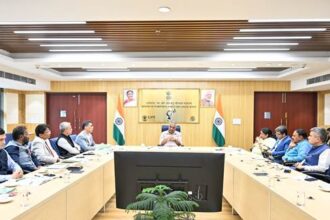
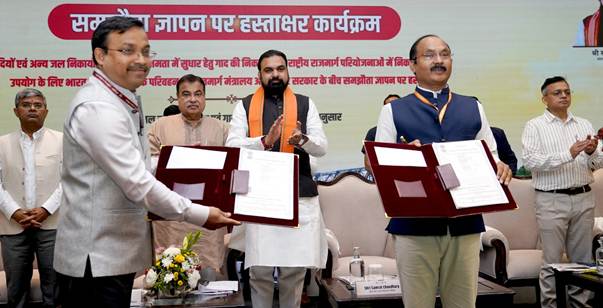
NEW DELHI — The Ministry of Road Transport and Highways (MoRTH) and the Government of Bihar entered into a Memorandum of Understanding (MoU) on Tuesday to scientifically extract silt from state waterways and repurpose the material for highway construction projects.
Signed in the capital by Union Minister for Road Transport and Highways Nitin Gadkari and Bihar Chief Minister Samrat Choudhary, the agreement establishes a collaborative framework titled the ‘Nadi Sanjivani’ initiative. The project aims to simultaneously mitigate severe seasonal flooding, restore natural river drainage capacity, protect fertile topsoil, and secure raw embankment material for major road projects.
Massive Material Recycling for Ongoing and Future Highways
Assessments by the National Highways Authority of India (NHAI) indicate that the initiative will supply roughly 243 lakh cubic metres of excavated river sediment to 16 active National Highway works across Bihar. An additional 835 lakh cubic metres is slated for integration into 27 upcoming highway projects, pending quality testing against Indian Roads Congress (IRC) standards.
Currently, 39 NHAI infrastructure developments spanning 1,561 kilometers are under active construction across Bihar with a capital commitment of ₹58,340 crore. A secondary pipeline includes 11 projects totaling 1,982 kilometers with an estimated investment of ₹1,85,200 crore. Reusing sediment for these links is expected to offset reliance on agricultural soil extraction while reducing overall material transportation expenses.
Speaking at the signing, Minister Gadkari highlighted the dual benefits of dredging silt-clogged riverbeds, particularly those fed by Himalayan inflows from Nepal:
“And when the economy grows, both the poor and the middle class benefit from it,” asserted Shri Modi.
Policy Governance and Technical Safeguards
The operational roadmap aligns with the recently established Bihar Water Sources Restoration and Silt Management Policy, 2026. Bihar’s Road Construction Department (RCD) will serve as the executive nodal agency, overseen by a joint State-level Coordination Committee tasked with issuing statutory clearances, monitoring extraction sites, and ensuring structural safeguards around bridge abutments and river embankments.
Chief Minister Samrat Choudhary noted that excessive sediment deposits following flood cycles have historically damaged agricultural land and disrupted rural livelihoods across the state. He emphasized that structured desilting will improve irrigation access, bolster groundwater recharge, and stabilize riverbanks.
The signing ceremony was attended by senior infrastructure leaders, including NHAI Chairman Santosh Kumar Yadav, Director General Sudeep Chaudhary, NHIDCL Managing Director Krishna Kumar, and Bihar State Secretaries Pankaj Pal and Atul Kumar.
According to an official statement issued by the Press Information Bureau (PIB), Delhi.