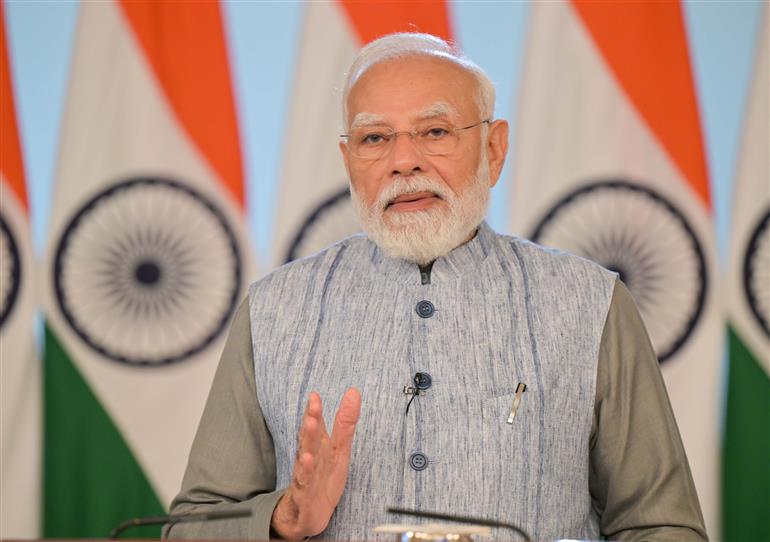
PUNE — Prime Minister Narendra Modi on Tuesday inaugurated and laid foundation stones for major transit developments under the Pune Metro umbrella, representing a total financial outlay of approximately ₹21,800 crore. Delivered via video conferencing, the infrastructural launch expands urban mass transit within the city, establishing direct connectivity across key commercial and residential corridors including the Hinjawadi to Shivajinagar route.
During his address, the Prime Minister emphasized that enhanced urban transit systems serve a critical economic function beyond standard commute management. By optimizing travel times, modern metro lines directly improve urban productivity, which serves to accelerate broader macroeconomic momentum.
“And in such a scenario, the strengthening metro connectivity here is going to give new momentum to the development of Pune city,” noted PM Modi.
National Transit Footprint and Economic Impact
The expanded Pune infrastructure mirrors a broader nationwide scale-up of mass transportation over the past 12 years. India’s active metro network currently spans roughly 1,200 kilometers across 26 cities, accommodating over one crore daily passengers. In Maharashtra alone, operational metro tracks have grown from roughly 11 kilometers in 2014 to nearly 175 kilometers today, with an additional 680 kilometers currently under construction backed by investments exceeding ₹2.5 lakh crore.
The Prime Minister highlighted that the newly launched Hinjawadi-Shivajinagar section was executed using a Public-Private Partnership (PPP) model, pointing to joint public and commercial investment as a key engine for future infrastructure deployment.
“Today the Indian metro network is counted among the top three metro networks in the world,” noted PM Modi.
Addressing broader economic parameters, the Prime Minister linked major public expenditure in urban and rural logistics directly to poverty alleviation metrics. Citing recent analytical data from the World Bank, he noted that approximately 50 crore citizens have transitioned out of extreme poverty over the past 10 to 12 years.
“Earlier, the fight against poverty was only in slogans, today India is defeating poverty on the ground,” asserted Shri Modi.
“Both these accomplishments are connected to each other,” noted PM Modi, highlighting the systemic link between rapid economic expansion and direct poverty reduction.
Support for Drought-Impacted Agricultural Sector
Beyond municipal development, the Prime Minister addressed agrarian distress across parts of Maharashtra stemming from adverse weather conditions and seasonal drought. Reassuring farming communities, he referenced ongoing relief operations, including advance state allocations and the direct disbursement of central PM-Kisan financial support.
“Do not worry at all, we are all with the farmers,” affirmed Shri Modi.
The government’s long-term urban strategy incorporates the newly approved Urban Challenge Fund, backed by ₹1 lakh crore in Central assistance aimed at leveraging private enterprise participation to transform secondary and tertiary towns into active regional economic centers.
According to an official statement issued by the Press Information Bureau (PIB), Delhi.