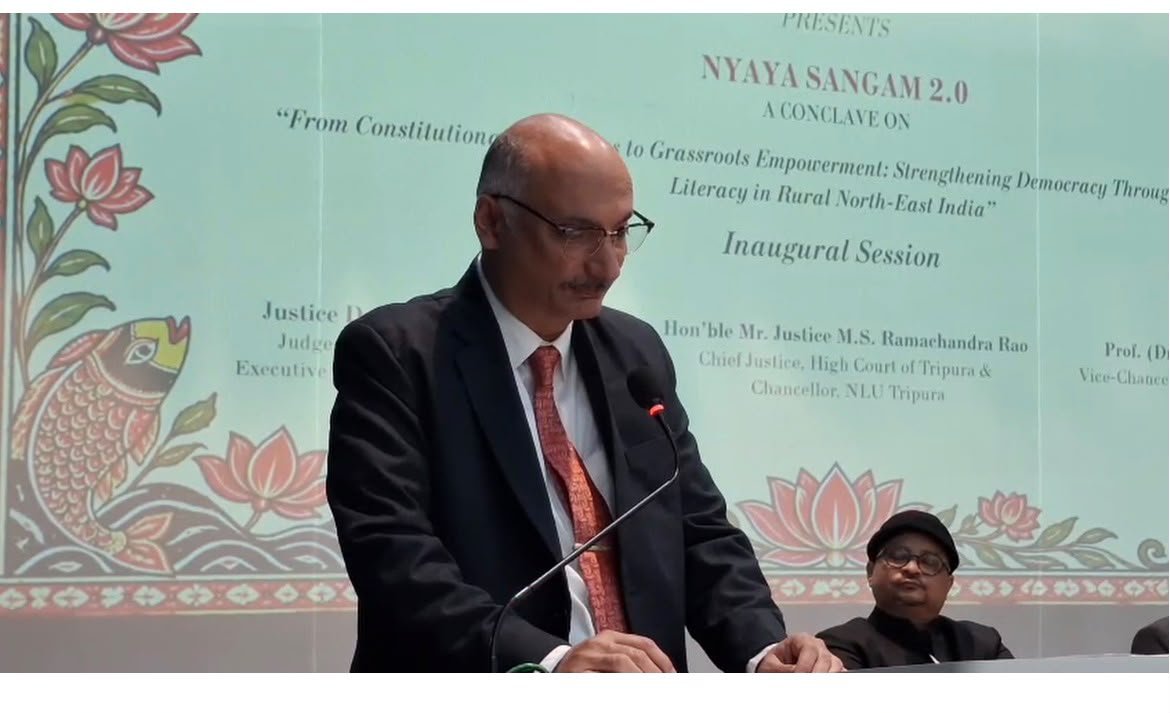
Senior jurists and academic leaders gathered in Agartala on Saturday, November 21, 2026, to urge deeper constitutional literacy and everyday civic practice in Tripura’s rural communities during the inauguration of the “Nyaya Sangam 2.0” conclave. Hosted by the Pro Bono Club of National Law University, Tripura, the gathering focused on bridging legal gaps in remote villages by partnering with local governance bodies and frontline institutions.
Opening the event, Tripura High Court Chief Justice M.S. Ramachandra Rao argued that familiarity with constitutional text alone is insufficient unless citizens internalize and apply its underlying rights, ideals, and democratic principles in daily life. To reach isolated settlements effectively, he pointed to grassroots channels such as Panchayats, regional-language media outlets, and open neighborhood dialogues.
Addressing the conclave’s push to reach Gram Panchayats and Village Committees statewide, Justice Dr. T. Amarnath Goud—a High Court judge and Executive Chairman of the Tripura State Legal Services Authority—called on young people to take an active stand against urgent social and legal challenges, naming drug trafficking, child marriage, offenses under the Protection of Children from Sexual Offences (POCSO) Act, and HIV. Meanwhile, National Law University, Tripura Vice-Chancellor Professor Yogesh Pratap Singh outlined the institution’s outreach support, noting that legal and technical aid is being extended to roughly 1,200 Gram Panchayats and Village Committees aiming to become constitutionally aware, tobacco-free, drug-free, and safe for children and women.
Across India’s federal system, constitutional guarantees often feel distant in geographically remote or hilly regions where legal institutions are concentrated in urban centers. Embedding legal literacy within local self-government bodies and pairing university pro bono initiatives with state legal services authorities reflects a wider shift toward preventive justice—helping residents recognize their rights early, resolve disputes locally, and address public health and child-protection risks before they escalate into court battles.
Sources: Agartala event proceedings and official statements from Nyaya Sangam 2.0 speakers.